
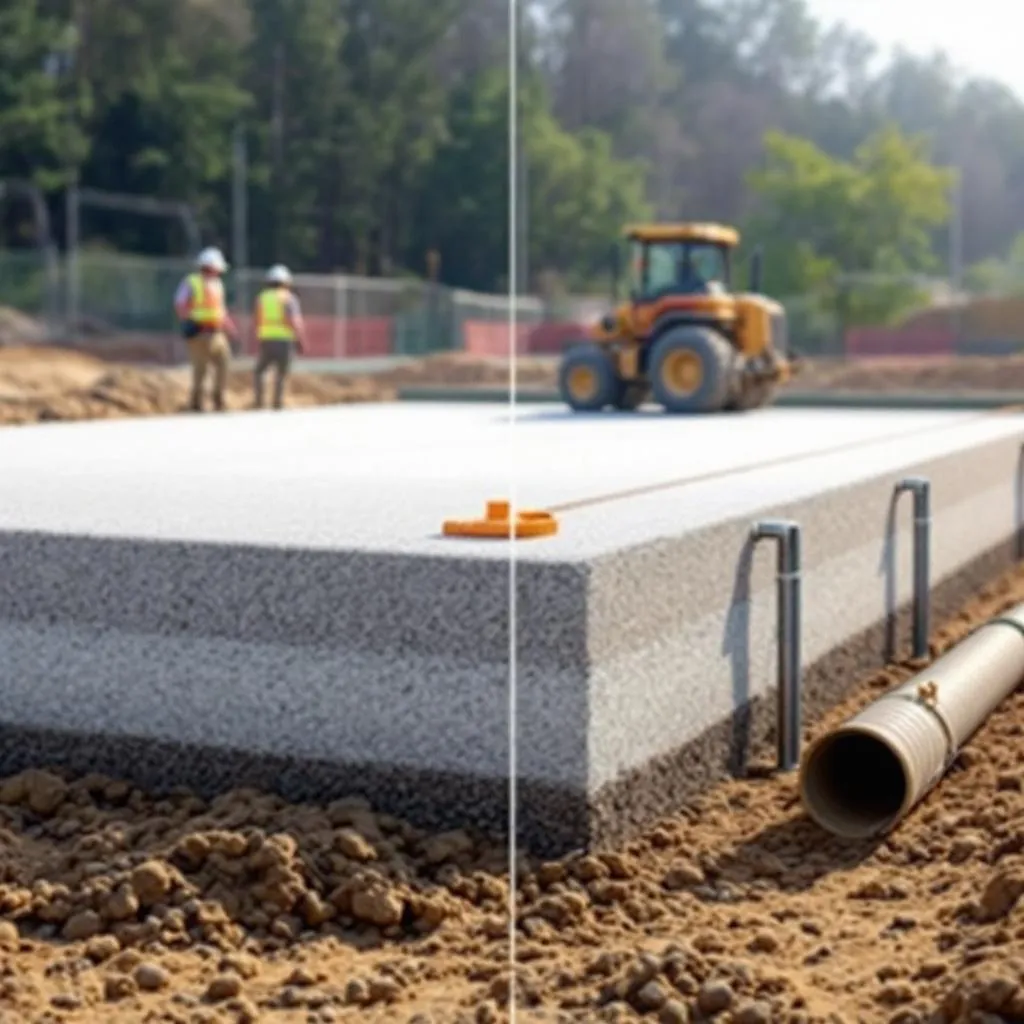
Sports Field Base Construction: The Foundation of Safe, High-Performing Sports Turf
If your sports field is uneven, holds water, or wears out too fast, the issue usually isn’t the turf on top—it’s the base underneath.
Proper sports field base construction is the single most important factor that determines whether your natural or synthetic sports turf will:
- Drain quickly after rain
- Stay level and safe for athletes
- Deliver consistent ball roll and bounce
- Last years longer before major renovation is needed
In other words: if the base is wrong, nothing else can be right.
If you’re planning a new field, a renovation, or trying to understand why your current field underperforms, start with the base.
What Is Sports Field Base Construction (and Why It Matters More Than Turf)
Sports field base construction is the process of building the layers underneath your turf system—natural or synthetic—that provide:
- Structural support (bearing the load of players, equipment, and weather)
- Smooth, stable playing surfaces (no dips, humps, or shifting)
- Proper drainage (moving water away quickly and safely)
- Consistent performance (speed, ball behavior, footing)
Think of it like this:
- Turf = The “skin” of the field (what you see and feel)
- Base = The “skeleton + circulation system” (what keeps it working)
If you invest in premium turf but skip proper sports field base construction, you end up with:
- Puddling or muddy zones
- Hard spots and soft spots
- Uneven compaction
- Safety risks and faster turf failure
The Core Layers of Proper Sports Field Base Construction
While every field has its own design requirements, most modern sports fields share a similar base structure. From the ground up, you’ll typically see:
- Subgrade (native soil layer)
- Sub-base (structural stone layer)
- Base layer (fine-graded stone for precision and stability)
- Surface system (natural turf or synthetic turf)
Let’s break down each one.
1. Subgrade: Preparing the Native Soil
The subgrade is the existing soil beneath the field. It must be:
- Stable (no soft pockets or organic debris)
- Uniformly compacted
- Properly sloped to support drainage design
Key steps include:
- Removing topsoil, organic matter, and unsuitable material
- Compacting to specified density (often 90–95% of Proctor density, project-dependent)
- Shaping the subgrade to match the design slope (e.g., 0.5–1.0% for many fields)
- Addressing soil issues (expansive clay, weak soils) through stabilization or replacement
Why it matters:
If the subgrade moves, settles, or holds water, the entire field structure above it suffers—leading to surface irregularities and drainage problems.
2. Sub-Base: The Field’s Structural Backbone
The sub-base is usually a deep layer of compacted stone (or sometimes stabilized material) placed over the subgrade. Its main jobs:
- Spread loads across a wider area
- Support heavy traffic (athletes, mowers, maintenance equipment)
- Help move water horizontally and vertically
- Provide a firm platform for the finer base layer
Common characteristics:
- Material: Crushed stone/aggregate with controlled gradation
- Depth: Often 4–12 inches or more (varies with climate, use, and drainage design)
- Installation: Placed in lifts and compacted to a design standard
Why it matters:
A properly built sub-base reduces settlement, protects the turf system, and supports consistent play—especially on heavily used competition or multi-sport fields.
3. Base Layer: Precision Grading and Surface Stability
The base layer is a finer, more carefully graded stone placed over the sub-base. This is where proper sports field base construction becomes highly precise.
Its main functions:
- Create a smooth, consistent platform for turf installation
- Fine-tune the field’s grade and plane
- Support the performance characteristics of the sport (e.g., ball roll, footing)
Key qualities:
- Material: Smaller, angular aggregates with specific gradation
- Thickness: Often 2–6 inches, depending on the system
- Tolerance: Very tight laser-controlled grading (often +/- a few millimeters)
Why it matters:
Small errors here translate directly into:
- Low spots and puddling
- Uneven ball bounce or roll
- Variations in firmness and safety
For synthetic turf, this layer is especially critical because it directly supports the turf system and infill.
4. Drainage: The Hidden System That Keeps Fields Playable
No matter how good your turf is, a poorly drained base will fail. Drainage design is an integral part of proper sports field base construction.
Typical drainage components:
- Perimeter drains to remove water from the edges of the field
- Collector and lateral drains under the field (for both natural and synthetic systems)
- Perforated pipes in gravel trenches
- Slope design (crowned or sloped fields) to promote surface runoff
For synthetic turf fields, designers may also use:
- Free-draining base stone systems
- Vertical drainage through turf backing and infill
- Underdrain networks integral to the base
Why it matters:
Effective drainage:
- Reduces field closures after rain
- Protects the turf system from saturation and breakdown
- Helps manage freeze–thaw cycles in colder climates
Natural vs Synthetic Turf: How Base Construction Differs
While the principles of stability and drainage apply to both, natural and synthetic turf systems require different base design details.
Natural Turf Fields
Key base considerations:
- Soil composition (sand-based vs native soil)
- Rootzone mix and depth
- Surface grading to move water off the field
- Sub-surface drainage beneath the rootzone
Base design aims to:
- Support healthy turf roots
- Balance firmness with resilience
- Avoid compaction that blocks root growth and drainage
Synthetic Turf Fields
Key base considerations:
- Precisely graded, stable crushed stone base
- Vertical and horizontal drainage through the base
- Compatibility with shock pads (if used)
- Long-term stability under high, repetitive loads
Base design aims to:
- Deliver consistent G-max and surface performance
- Enable quick drainage through the turf and base
- Maintain grade over many years of intensive use
The takeaway:
Even though the visible surfaces differ, both systems rely on proper sports field base construction to stay safe, playable, and durable.
How Proper Sports Field Base Construction Affects Performance and Safety
The quality of your base shows up in every minute of play. It directly affects:
-
Traction and footing
- Stable base → consistent footing & fewer slips
- Poor base → soft spots or hard spots = higher injury risk
-
Ball behavior
- Even base → predictable bounce and roll
- Uneven base → dead spots, irregular bounces
-
Impact and shock absorption
- Correctly engineered base → controlled firmness
- Overly hard or inconsistent base → increased stress on joints
-
Surface drainage and downtime
- Well-drained base → faster return to play after rain
- Poor drainage → standing water, canceled sessions, turf stress
Common Mistakes in Sports Field Base Construction
When fields underperform, base-related mistakes are often to blame:
-
Inadequate subgrade preparation
- Leaving organic material or soft pockets
- Failing to compact and stabilize weak areas
-
Improper materials or gradation
- Using “whatever stone is available” instead of specified aggregate
- Mixing materials that don’t drain or compact correctly
-
Poor compaction
- Inconsistent densities across the field
- Future settlement and uneven surfaces
-
Insufficient drainage design
- Too few drains or improperly sloped piping
- Ignoring local rainfall patterns and soil conditions
-
Skipping precision grading
- “Eyeballing” slope instead of laser grading
- Tolerances that are too loose for sports performance needs
Avoiding these issues is central to proper sports field base construction and long-term success.
Planning a New Sports Field? Questions to Ask About the Base
Whether you’re a facility manager, athletic director, or part of a design committee, ask these base-focused questions early:
- How will the subgrade be evaluated and prepared?
- What are the specified materials and layer thicknesses for each part of the base?
- What compaction standards will be used?
- How is drainage being handled—both on the surface and below?
- What slope tolerances and laser-grading standards are specified?
- How does the base design account for local climate (rainfall, freeze–thaw, heat)?
- What testing and verification will be done before installing turf?
These questions help ensure the base isn’t treated as an afterthought—but as the core of the project’s success.
How Base Construction Impacts Synthetic Track and Turf Systems
The importance of base design isn’t limited to fields alone. Synthetic track and turf systems rely just as heavily on well-built base structures.
A properly engineered base can:
- Provide precise flatness required for running tracks
- Deliver consistent resilience and traction around field perimeters
- Integrate field and track drainage so neither system negatively affects the other
- Extend the life of both the synthetic track surface and the sports turf they surround
If you’re considering or managing a complex with both a field and a running surface, understanding base design across systems is critical.
Learn more about how base construction and design interact with synthetic surfaces on our dedicated page: Synthetic Track & Turf.
Maintenance and Monitoring: Protecting Your Investment in the Base
Once your base is built, you don’t just forget about it. While most maintenance happens at the surface level, it’s ultimately about preserving base integrity.
Ongoing steps include:
-
Regular surface inspections
- Look for low spots, depressions, recurring puddles
- Track patterns that might indicate base movement
-
Drainage checks
- Confirm outfalls and drains remain clear
- Watch how quickly water disappears after storms
-
Load management
- Limit heavy vehicle traffic or use defined access routes
- Prevent rutting and localized compaction above drains
-
Professional assessments before resurfacing
- For synthetic turf replacement, evaluate base condition
- For natural turf renovations, test compaction and drainage
Protecting the base maximizes the lifespan and performance of whatever turf system you have installed above it.
FAQ: Proper Sports Field Base Construction
| Question | Answer |
|---|---|
| What is the most important part of sports field base construction? | The most important part is a combination of stable, well-compacted subgrade , properly graded stone layers , and a functional drainage system . All three must work together. |
| How deep should the base be for a sports field? | It depends on soil conditions, climate, and field use, but many synthetic fields have 6–18 inches of stone-based structure above the compacted subgrade. Natural turf fields may use shallower stone layers but include a rootzone profile. |
| Can I reuse an existing base when replacing turf? | Sometimes. If the base is stable, drains correctly, and meets modern tolerances, it can often be reused with minor repairs and regrading. A professional evaluation is essential before deciding. |
| Why is drainage such a big part of proper sports field base construction? | Because drainage controls playability, safety, and durability . Without effective drainage, even the best turf will suffer from puddling, soft spots, and early failure. |
| Does base construction differ between soccer, football, and multi-use fields? | The core principles are the same, but the performance requirements (ball roll, firmness, shock absorption) and usage patterns can lead to different design details and tolerances. |
| How long should a properly built sports field base last? | A well-designed and constructed base can often support multiple turf cycles (especially for synthetic fields), with periodic inspections and minor repairs, rather than full reconstruction. |
| Is proper sports field base construction only important for professional venues? | No. High schools, colleges, municipalities, and clubs all benefit from good base construction. It reduces maintenance, improves safety, and maximizes field availability at every level. |
| How does base construction affect synthetic track and turf systems together? | The base must support both the precision flatness of the track and the performance of the turf field , while managing shared drainage and structural loads. Poor coordination can cause cracks, puddles, or uneven surfaces at the interface between track and field. See more at Synthetic Track & Turf . |
Key Takeaways: Why the Base Deserves Your Attention
- Proper sports field base construction is the foundation of safety, performance, and longevity.
- The visible turf—natural or synthetic—depends on what’s underneath it.
- Good base work focuses on:
- Stable, well-prepared subgrade
- Correctly specified stone layers
- Precision grading and compaction
- Thoughtful, site-specific drainage design
- Investing time and attention in base construction now reduces problems, costs, and downtime later.
When you understand the importance of the base, you’re better equipped to ask the right questions, evaluate design choices, and protect your field for years of reliable play.
Explore Related Turf Resources
Related Turf Guides
- Apartment Patio Turf Solutions: How to Transform Small Spaces Fast
If you’re searching for apartment patio turf solutions, you’re likely asking one core question:
- Commercial Environmental Compliance for Turf: What It Is and Why It Matters Right Now
If you manage or influence any commercial property with turf—corporate campuses, schools, sports fields, HOAs, retail centers—**commercial environmental compliance for turf** is no longer “nice to ...
- Commercial Rooftop Turf: The Fastest Way to Turn Unused Roof Space into Usable Square Footage
If you’re wondering how to transform a bare, hot rooftop into something people actually want to use, commercial rooftop turf solutions are often the most practical starting point.
- Commercial Turf Cost: What You Should Really Expect to Pay
If you’re looking for a fast, realistic answer on **commercial turf cost**, here it is:
- Cool Turf for Play Areas: How to Keep Playground Surfaces Safer and More Comfortable
If you’re searching for **cooler turf for child play areas**, you’re probably worried about one thing first: **heat**.