
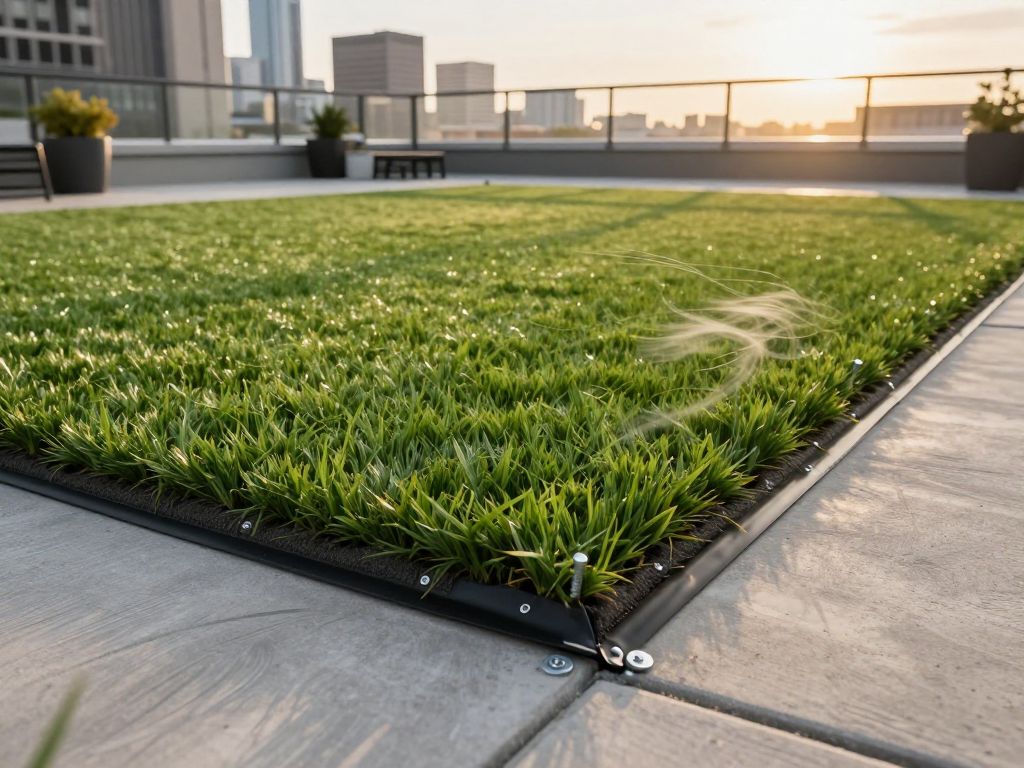
The Definitive Guide to Wind-Proof Artificial Turf for DFW Rooftops and Patios
##?
Wind-proof artificial turf installation involves securing the synthetic grass using a combination of heavy-duty ballast (like infill), high-strength, flexible adhesives along all perimeter edges and seams, and perimeter fastening (often concrete screws or nails) to permanently bond the turf to the rooftop or patio base, ensuring the system remains stable and resists powerful uplift forces common in the DFW area.
2. Deep Dive (Detailed Why and How)
The Engineering of Wind Resistance
When installing artificial turf on elevated surfaces, like balconies or rooftop patios, the primary challenge is uplift—the force generated by wind moving under the edges of the turf, attempting to pull it away from the surface. A successful "wind-proof" system is designed to counteract this force effectively.Foundation and Ballast
The first defense against wind is weight. After the turf is laid, a dense layer of infill (typically specialized sand or granulated rubber) is brushed into the fibers. This ballast adds significant mass per square foot, making it physically harder for the wind to lift the material. For high-wind zones, installers may increase the density or type of infill used.The Role of High-Performance Adhesives
The perimeter and all seams of the turf are the most vulnerable spots. To eliminate these weak points, professional installers use industrial-grade, moisture-curing polyurethane adhesives. These specialized glues create a permanent, flexible bond between the turf backing and the concrete or decking substrate. It is crucial that the adhesive is not only strong but also rated to withstand Texas's extreme temperature swings, which can cause materials to expand and contract.Mechanical Fastening for Edges
For maximum wind resistance, relying solely on adhesive is often insufficient, especially on concrete or tile patios. Professional installations incorporate mechanical fasteners, such as concrete screws, perimeter nailing, or anchor pins. These fasteners are drilled through the turf backing and into the hard surface around the edges, then covered and sealed with adhesive to ensure a clean, permanent edge that wind cannot penetrate.
3. Quick Reference (Bulleted Key Takeaways)
- Infill Ballast: Essential weight (mass) added to the turf fibers to prevent uplift.
- Perimeter Adhesion: Use specialized, flexible, high-strength adhesive on all exposed edges and seams.
- Mechanical Security: Employ concrete fasteners around the entire perimeter for structural integrity.
- Substrate Preparation: Ensure the concrete or decking is clean and properly primed for maximum bond strength.
4. Strategic Hyperlink
To understand the full scope of secure installations on elevated structures, review our detailed guide on the various wind-resistant installation methods.
Explore Related Turf Resources
Related Turf Guides
- Apartment Patio Turf Solutions: How to Transform Small Spaces Fast
If you’re searching for apartment patio turf solutions, you’re likely asking one core question:
- Commercial Environmental Compliance for Turf: What It Is and Why It Matters Right Now
If you manage or influence any commercial property with turf—corporate campuses, schools, sports fields, HOAs, retail centers—**commercial environmental compliance for turf** is no longer “nice to ...
- Commercial Rooftop Turf: The Fastest Way to Turn Unused Roof Space into Usable Square Footage
If you’re wondering how to transform a bare, hot rooftop into something people actually want to use, commercial rooftop turf solutions are often the most practical starting point.
- Commercial Turf Cost: What You Should Really Expect to Pay
If you’re looking for a fast, realistic answer on **commercial turf cost**, here it is:
- Cool Turf for Play Areas: How to Keep Playground Surfaces Safer and More Comfortable
If you’re searching for **cooler turf for child play areas**, you’re probably worried about one thing first: **heat**.